
Korea Real Estate Trends: How People Buy in 2026
- Joon Kim

- 4 hours ago
- 5 min read

Korea’s real estate market is no longer driven by volume or speculation. It’s shaped by who can still buy, where they are buying, and why prices hold even when transactions slow.
Demand is concentrating in rare, high-quality assets—especially prime Seoul apartments, larger units, and well-known branded complexes.
Based on real transaction data, observed buyer behavior, and deal patterns in Seoul’s prime districts, this article explains what’s actually happening beneath the headlines.
Korea Housing Market Is Rising — Selectively
Korea’s market looks like it’s recovering, but it’s not a “rising tide lifts all boats” moment. Buyers are simply becoming more picky. In practice, that means prime location + scarcity + proven quality wins, while weaker assets stay flat or lag.
A real signal of this selectivity is what happened to large apartments in Seoul. Recent Korean reporting, based on official/industry indices, shows large-unit pricing held up strongly even under tighter lending because demand is still concentrated in “one premium home”. Large units (over 135㎡) rose around 10% in 2025.
What changed compared to earlier cycles:
People are less interested in “any property will go up.”
They focus on resale safety and long-term livability.
The buyers who are still active tend to have stronger capital and clearer criteria.
Seoul Is Driving Korea’s Real Estate Demand
Korea’s national averages can look stable, but the reality is that Seoul behaves like a different market. That’s the “illusion of averages” - the country can look flat while core Seoul is quietly pulling away.
This divergence is visible in price trends for mid-sized apartments (85–102㎡). Over the past decade, Seoul prices have consistently outpaced other regions, with Gangnam-gu now trading far above both the Seoul average and the national range. Even during periods of correction, Seoul prices recovered faster and held higher than surrounding markets.
In 2026, this gap is likely to widen because:
Supply is tighter in Seoul than in many other regions.
The jeonse-to-rent shift increases monthly burden and makes “secure assets” feel more attractive.
Buyers care more about liquidity (how easily it resells) than “getting the cheapest price.”
If you’re explaining this to a beginner, the simplest rule is:
Seoul prime = demand has many reasons to stay.
Non-core = demand needs a special reason to appear.
That’s why asking “Is the market up or down?” misses the point. A more useful question is which homes continue to be chosen as buyers become more selective.

Scarcity Rewards the Best Addresses
When supply drops, the market usually doesn’t rise evenly. It becomes more divided: top areas stay strong, and everything else fights for attention.
In Seoul, upcoming move-in volume (apartment completions) drops sharply, from roughly 31,856 units in 2025 to about 16,412 units in 2026—nearly a 50% decline. Market trackers and brokerage pipelines are already treating 2026 as a supply-gap year, especially in core districts.
Why this matters for prices:
If fewer new homes arrive, buyers compete more for “already-proven” homes (good location, good complex, good layout).
It increases the premium on large units because supply is naturally limited and harder to replace.
This supply pressure doesn’t play out evenly across Seoul because the market is tiered by neighborhood.
Top-tier districts: Seocho-gu and Gangnam-gu, with the highest prices per square meter
Upper mid-tier districts: Songpa-gu and Yongsan-gu, often the next choice for premium buyers
Mid-tier districts: Mapo-gu, Seongdong-gu, and Gangdong-gu, attracting buyers balancing price and location
Outer districts: More affordable, but with softer demand when supply tightens
When supply tightens, demand concentrates first in higher-tier districts—reinforcing price resilience there rather than lifting the entire city evenly.

Luxury Housing in Korea Is About Lifestyle Now
In 2026, “luxury” in Korea is no longer just about a bigger home or a better view. It’s increasingly about the living experience—privacy, security, services, and a sense of exclusivity.
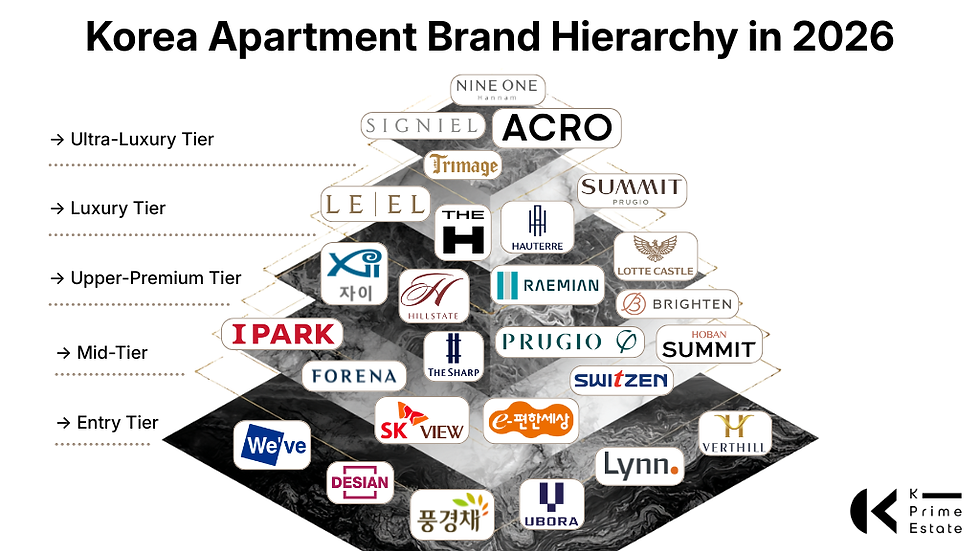
What we see in top-tier Seoul developments is a clear brand-driven shift. Ultra-luxury names sit at the top of the hierarchy, setting expectations closer to high-end hotels than traditional apartments. Developers compete on controlled access, curated amenities, and a more managed, private lifestyle.
A practical way to explain the new luxury logic:
Old luxury: “How big is it?”
New luxury: “How does it feel to live there every day?”
That experience is shaped by:
stronger security and private circulation,
higher-quality shared spaces designed for residents,
concierge-style services,
and layouts that prioritize privacy over scale.
This is also why Korea’s housing market is clearly split by brand:
Ultra-luxury residences sell a complete lifestyle package—service, privacy, and prestige.
Branded apartments still win on location and scale, but increasingly borrow hotel-style features to stay competitive in higher tiers.
Cash Buyers Keep Korea’s High-End Market Firm
Luxury prices can stay firm even when transaction counts are lower, because the buyer mix is different. Stricter lending filters out leveraged buyers, but cash-rich buyers can still buy—and they’re the ones setting the price tone in prime areas.
This shows up clearly in 2025 transaction data. Seoul’s highest-priced sales were concentrated in Seongdong-gu, Yongsan-gu, Gangnam-gu, and Seocho-gu, with individual units selling from $8M to nearly $20M USD. Most of these deals involved large units over 200㎡, confirming that demand at the very top stayed active despite tighter conditions.
A simple way to say it:
Regulations can reduce how many people can buy.
But they don’t always reduce the price of what wealthy buyers still want.
That’s why ultra-high-end assets often act more like “capital preservation homes” than normal housing.

What Home Buyers Should Know in 2026 (simple decision rules)
The best assets will not become cheaper just because activity slows. Waiting for broad market signals may mean missing rare opportunities.
Key takeaways:
Transaction volume is a poor signal at the top
Quality assets rarely reprice downward
Timing matters less than access and readiness
For serious buyers:
Focus on unit quality, not averages
Watch who is buying, not how many
Understand regulation as a filter, not a warning sign
Quiet Confidence: Global Buyers Choose Korea
Foreign interest in Korean real estate is expanding in a stable and constructive way, reflecting long-term confidence rather than short-term speculation. What stands out is not volume, but quality and focus:
Steady growth: Foreign home ownership has continued to rise through 2025, signaling sustained global interest. Foreign-owned homes rose from 100,216 at the end of 2024 to 104,065 by mid-2025, roughly +3.8%.
Prime-only demand: Buyers concentrate on top Seoul neighborhoods with strong livability, international appeal, and proven resale liquidity.
Long-term mindset: Most purchases are cash-driven and held for lifestyle use or long-term value preservation, not quick flips.
Market stability: Because demand is selective and supply in premium areas is limited, foreign participation supports price resilience rather than volatility.
For global buyers, this points to a market that is disciplined, transparent, and aligned with long-term value creation rather than speculation.
The Bottom Line
Korea’s real estate in 2026 isn’t about timing the cycle. It’s about selection. Supply gaps, Seoul-centric demand, evolving luxury standards, and gradual foreign interest all reward the same thing: rare, high-quality assets that buyers continue choosing even when conditions are tough.
